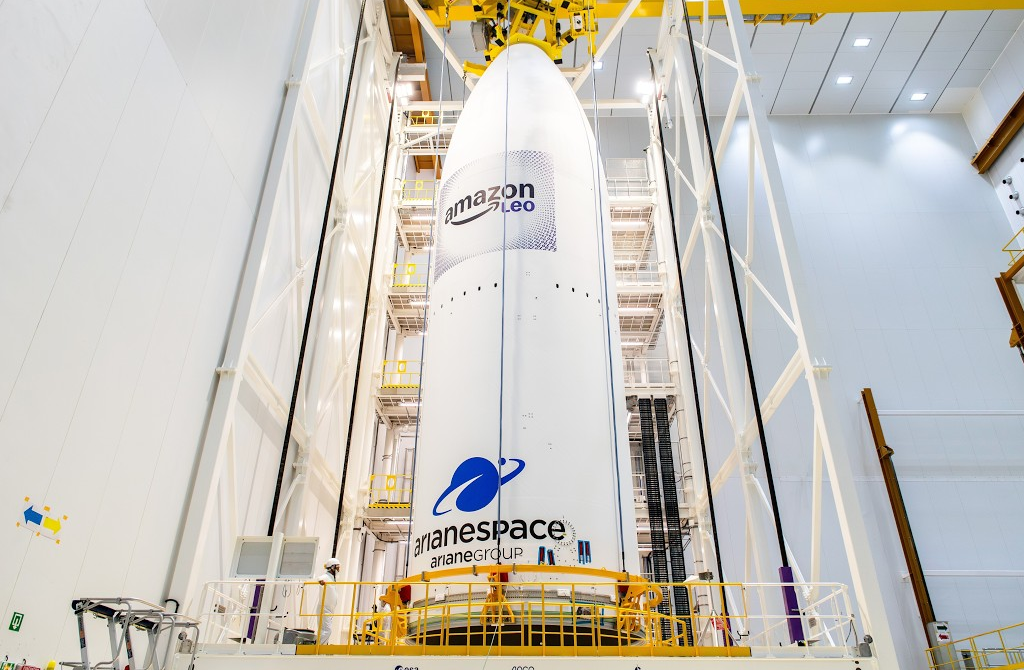
Arianespace readies Amazon Leo launch
Arianespace is preparing for the launch of 32 Amazon Leo satellites on April 28, 2026, from the Spaceport at Kourou, French Guiana. This mission marks the second flight of the Ariane 6 rocket, designed to enhance global connectivity services. The satellites are designated LE-02 and are part of a broader deployment strategy for Amazon Leo's constellation.

A look back at 2025 for Europe’s Spaceport
Europe's Spaceport in French Guiana achieved a significant milestone in 2025, returning to full autonomous launch capability with Ariane 6 and Vega-C. Key launches included MetOp-SG-A1, Sentinel-5, and the CSO-3 satellite. The P160C solid rocket motor test marked a crucial development, enhancing Europe's competitive edge in space access and sustainability for future missions.

Ariane 6 and Vega-C over Earth (artist impression)
Ariane 6 and Vega-C rockets are depicted in an artist's impression soaring over Earth. Ariane 6 can be configured with four boosters, enabling it to deliver over 15 tonnes to a 500 km polar orbit. Vega-C supports European institutional missions with a capacity of 2.2 tonnes to a 700 km polar orbit, utilizing P120C boosters.

Preparing first Ariane 6 with four boosters and liftoff
Arianespace's Ariane 6 rocket, equipped with four boosters, was successfully launched carrying 32 satellites for Amazon Leo. The central core arrived at the launch pad on January 21, 2026, followed by booster installations completed by January 22. Liftoff occurred on February 12 at 13:45 local time, with satellite separation achieved after 114 minutes in low-Earth orbit.

Highlights of first launch of Ariane 6 with four boosters
Ariane 6 successfully launched at 16:45 GMT, marking its first flight with four boosters, delivering 32 Amazon Leo satellites to orbit. This Ariane 64 configuration enhances payload capacity to 21.6 tonnes for LEO, doubling the performance of the two-booster variant. The P120C boosters are among the most powerful one-piece motors globally, elevating Ariane 6's capabilities.

Everything rockets
ESA's Ariane 6 and Vega-C rockets represent Europe's advancements in space transportation, enhancing launch capabilities for various missions. Space Rider, a reusable laboratory, is set for its inaugural flight in 2025. The Future Launchers Preparatory Programme aims to ensure future rockets meet evolving performance and reliability standards, supporting Europe's ambitions in space exploration and satellite deployment.